Choosing the right light for your space can be a challenge. This post is based off of a resource thread originally shared on Twitter, designed to highlight various design solutions I’ve implemented into my own space and the benefits they have – allowing you to replicate them for your own space.
Warm Glowing Ambiance Light In The Kitchen:
To really create a warm atmosphere while still having strong focal lighting for both my kitchen sink and island, I chose dark black painted pendant lights with brass interiors.
These are the interiors of both my kitchen sink fixture and one of my island pendant lights:
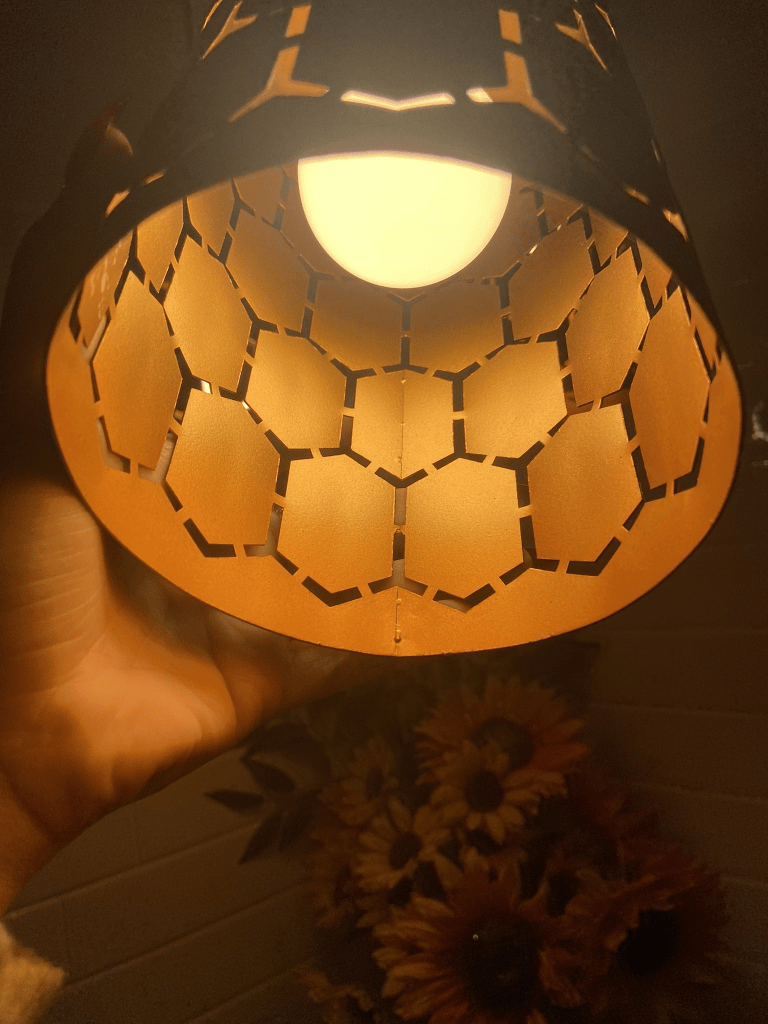
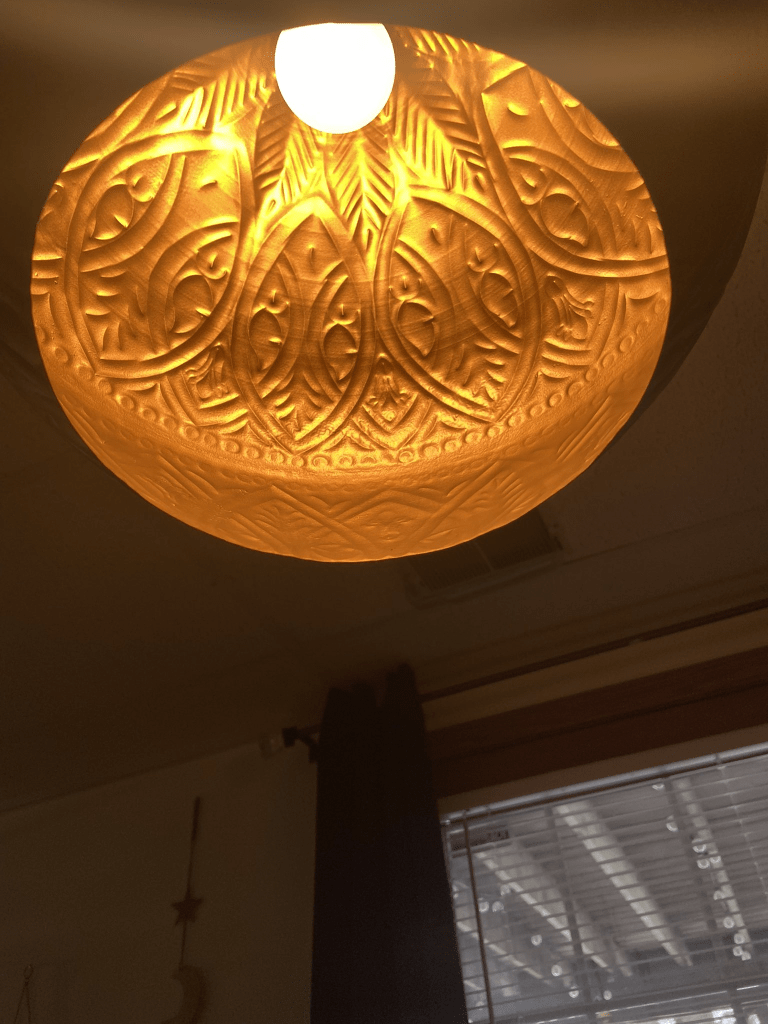
This type of light fixture dampens the bulb. You can see I am able to use a standard LED bright white bulb and the bronze surround changes the intensity without the need for fancy bulbs.
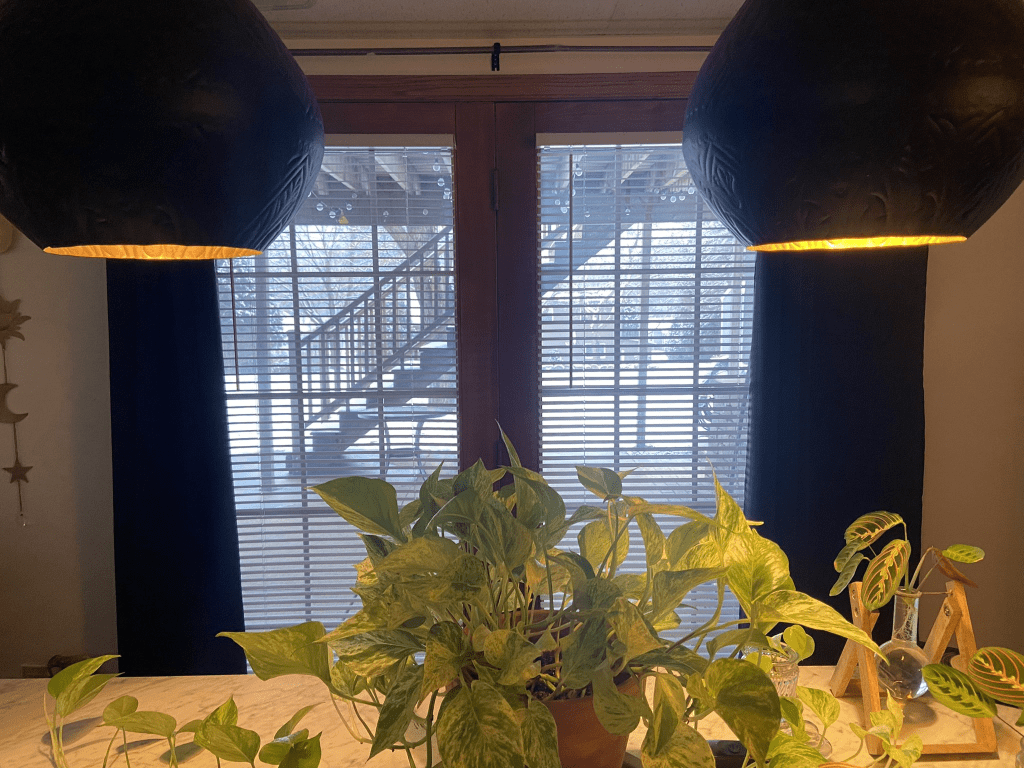
Focusing on the kitchen island, you can see the light fixtures provide a warm lighting to work under, but the enclosed aspect of the pendant prevents me from being head on with any of my light sources. Both light fixtures function as direct task lighting while giving the overall feel of the kitchen a manageable ambiance that is comfortable even with light sensitivity.
Working in a kitchen can require even brighter light for some tasks like chopping. To solve this problem while also working to remain migraine friendly, I installed under cabinet lights:
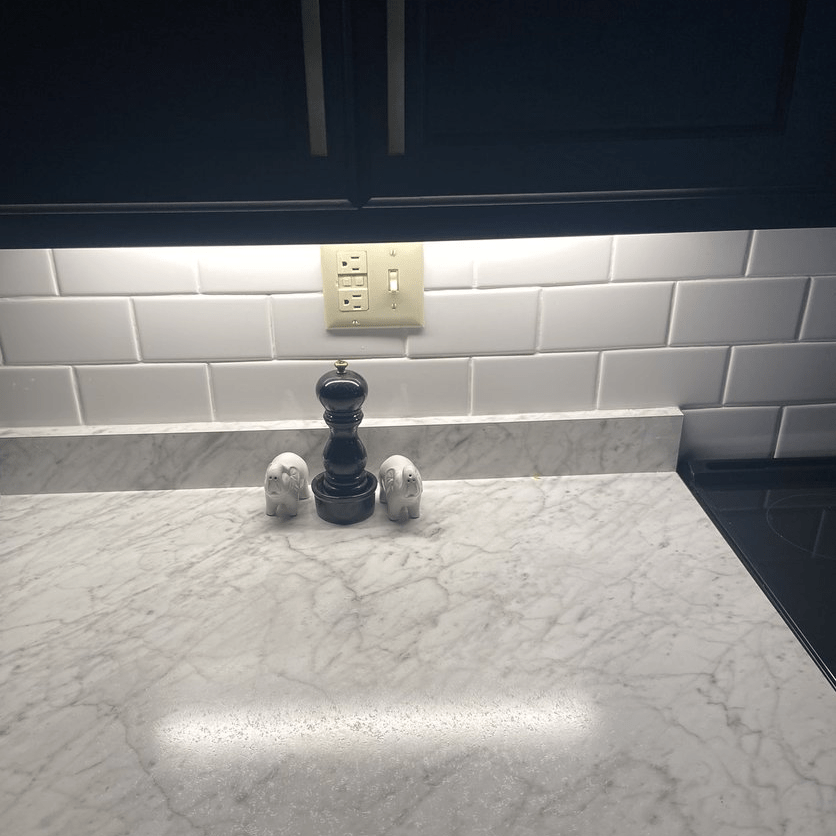
These lights tend to be much harsher and therefore less friendly when experiencing a migraine, however depending on both your height and the height you mount your cabinets at, your under cabinet lighting will often be mounted above your work surface but below your eye level.
By combining both the ambiance focused warm light fixtures as the primary light source for the kitchen with the under cabinet fixtures allows the kitchen to remain fully functional and migraine friendly. Of course, should others intend to use my kitchen there are additional overhead lights in the room that are as bright as this undercabinet fixture, so for shared spaces you may find value in taking a triple layered lighting approach.
Playing With Bulbs and Paint To Change Brightness
I personally live within two extremes of colors, my walls are either white or black. In my living room, it’s split so half the room is black and half is white. Again, I don’t use my overhead lights so I primarily illuminate my space with accent lighting.
The main light source above my couch is a grouping of three rattan pendants:
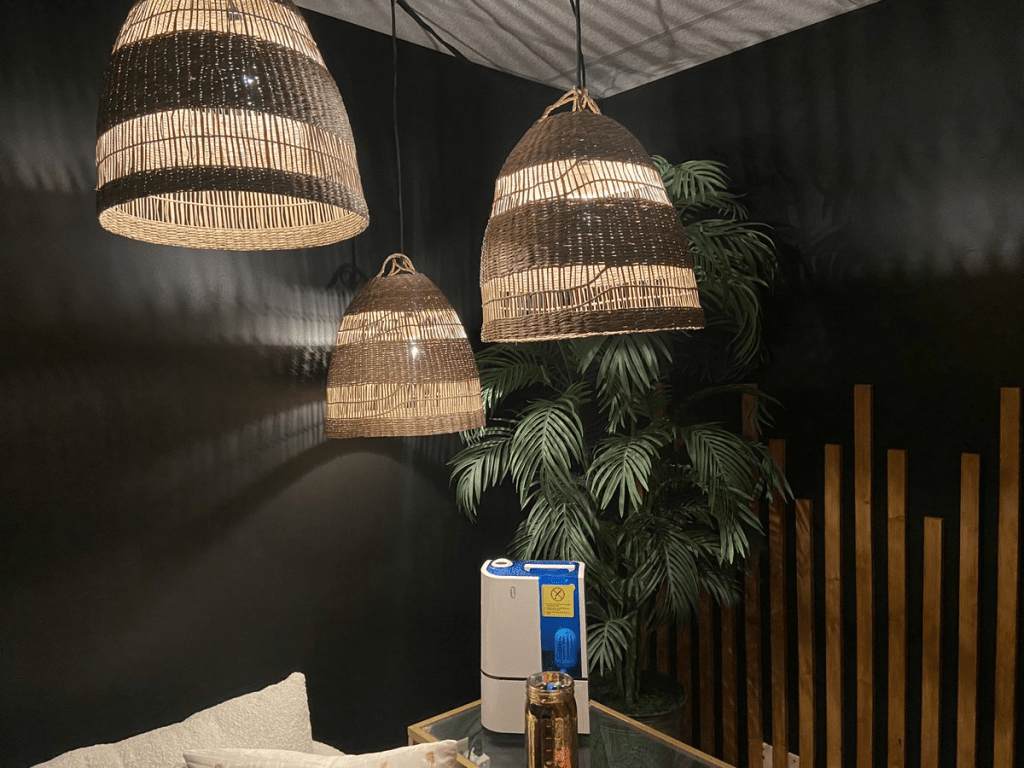
I have chosen to use 40W vintage bulbs and additionally have these pendants plugged into a dimmer so they can be incredibly muted at their lowest setting.
Being contained by the dark walls gives the light source a warm glow, but diffuses the light to a far more comfortable level.
On the opposite end of my couch, I have a secondary light fixture:
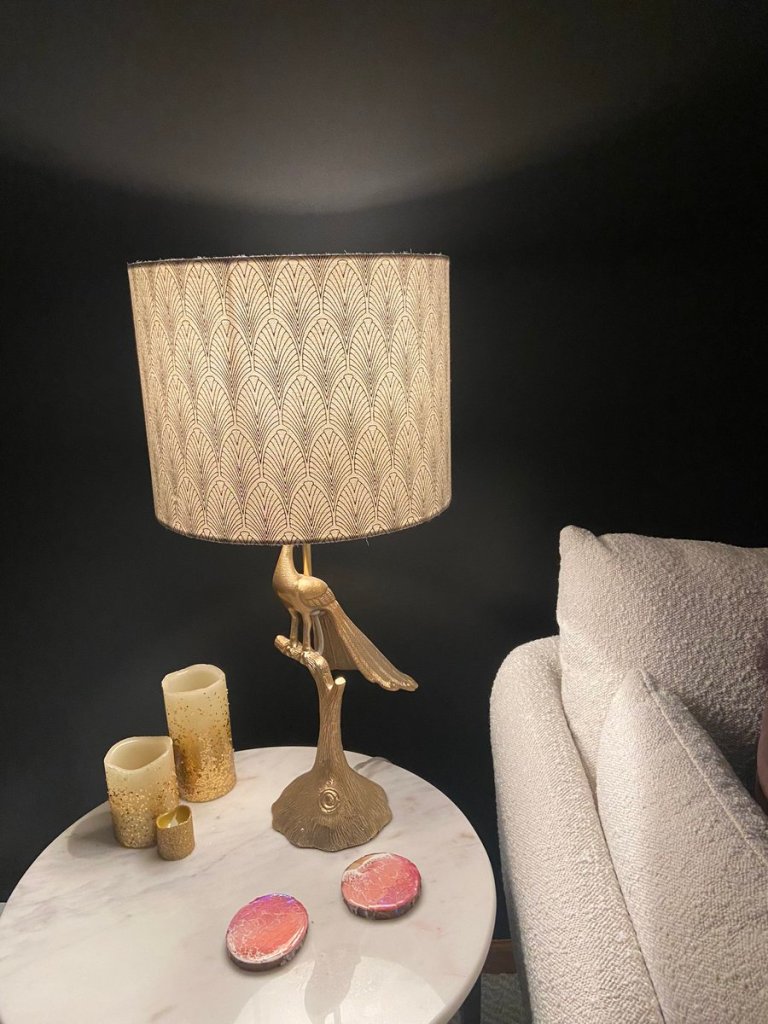
This lamp has brighter attributes than the rattan, such as a the white lampshade which allows it to feel a little brighter. The white marble tabletop also has a glossy finish which will reflect even more light.
I am still using the 40 W light bulb in this lamp. You can see how it illuminates the table brightly, but from the top against the black wall the light is able to quickly diffuse.
I highlight this example without the dimmer switch to show how the darker paint allows light bulbs to put off strong light, but remain softened due to their surroundings.
On the opposite end of this room where my office is set up, the desk is corned by two white walls. To adapt this space to be flexible for different light sensitivity needs and functional uses I have layered the lights even further:
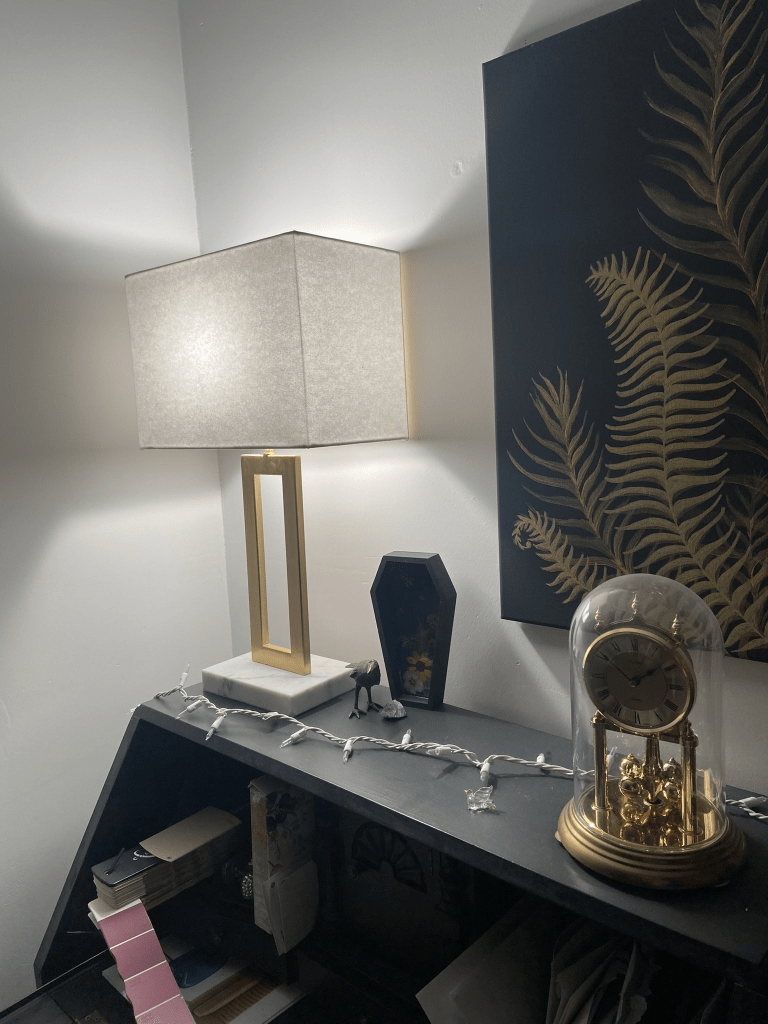
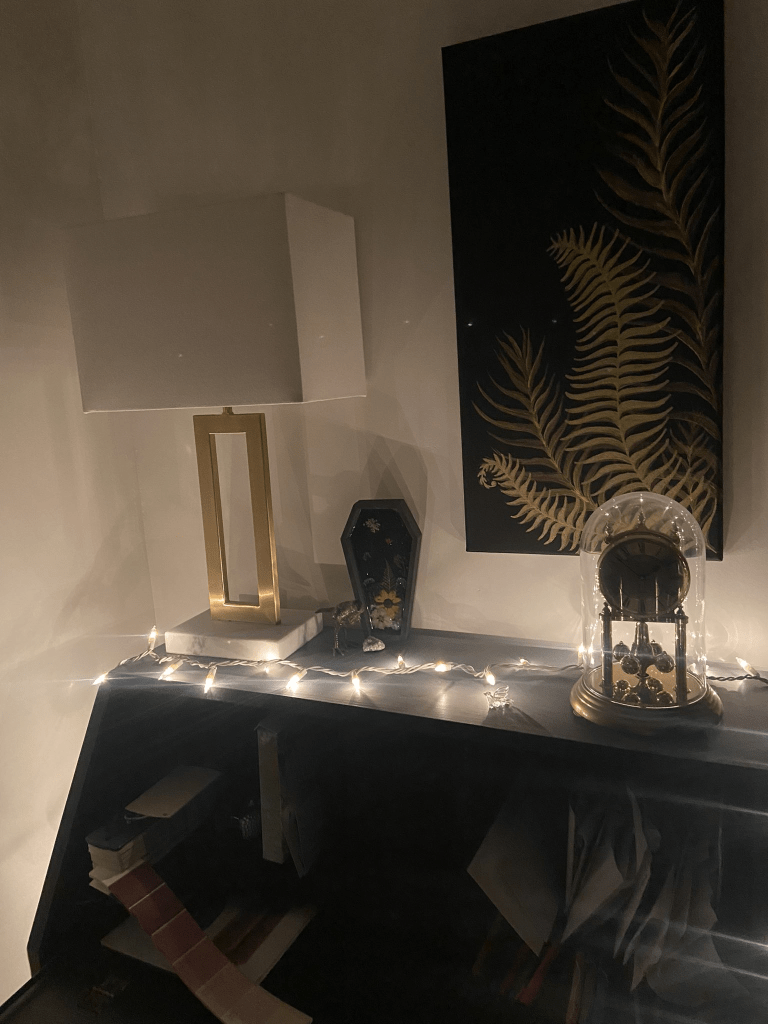
In both photos the overhead light remains off. I have a brighter 72W LED bulb in my lamp. You can see how this light is not only rather cold in tone against the white walls, but appears to travel further on the brighter white. This lamp allows both the downlighting to act as a task light for working at the desk and the up lighting to illuminate the entire corner.
As a secondary layer, as “kiddish” as string lights may be – they are available in so many styles from traditional Christmas lights, to nicer quality copper strung twinkle lights that provide a bit more elegance than I’ve opted for. Kiddish or not, they make for the perfect final lighting layer in any space. With the overhead light and lamp turned off, I could work at my desk – often working on my computer – and not be seated in the complete dark. The string lights provide a warm glow and a subtle light source.
Mixing In Natural Light:
Taking the ideas from my living room, which has no natural light source, and designing a migraine friendly bedroom with a big ole window means that you want to combine many of the ideas to make a functional space.
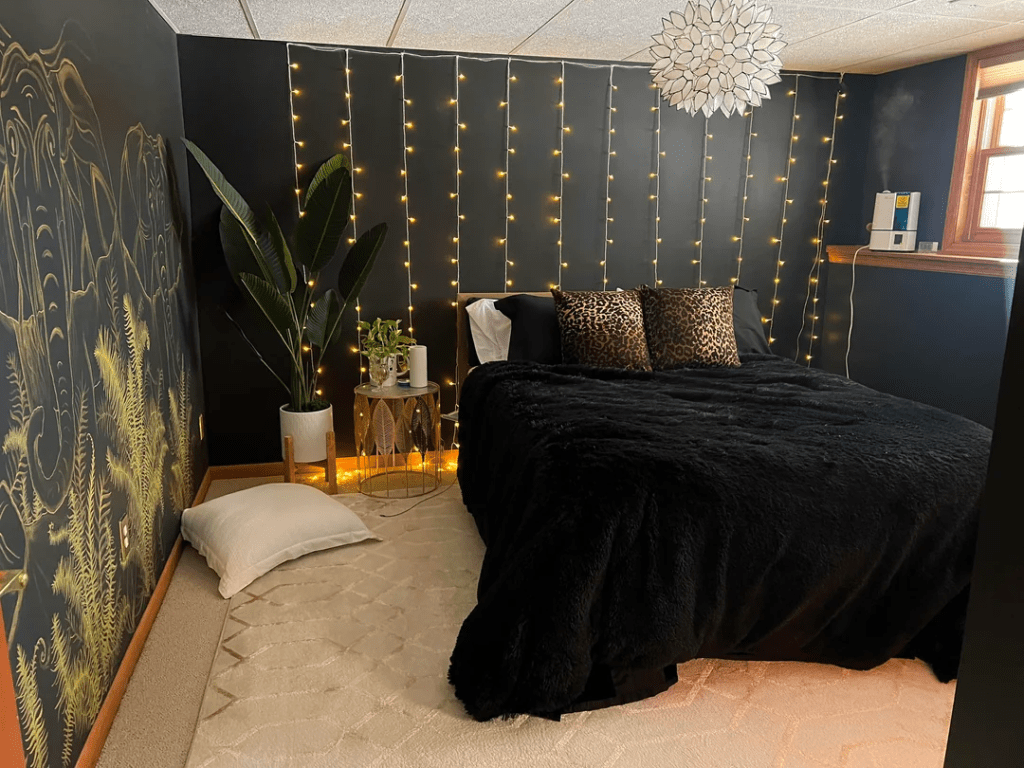
For a space like this the primary goal is to have an oasis for sleeping, so I started with the black walls. This automatically forces the room to be darker, pictured above is the brightest part of the day where the sun shines directly into the room.
Since the sun isn’t shining all the time, the primary light fixture actually has a bright 72W LED bulb. In a space of this size, it doesn’t actually provide much light, and the Capiz shells break up the light a bit further preventing it from being so harsh. This works in my favor as it’s never too bright to turn on. If I did want something with more output, the solution for a darker room such as this one would be a different fixture that had multiple bulbs and less obstruction between the bulb and the surrounding room.
Secondary to the overhead light, is the wall of curtain lights – another fun way to incorporate twinkle lights into your space.
At night especially this provides the perfect ambiance for the space that allows you to unwind from your day in what feels like a candle lit oasis.
Changing Bulbs to Alter Light
The final main point about light is that you can amend your light bulbs beyond adding dimmer switches to completely change the experience of just about any light fixture.
The first adjustment requires an adaptor – they sell adaptors for standard base light fixtures that allow you to use a smaller bulb. I use these adaptors primarily in my hanging rattan pendants to allow the use of my 40W vintage bulbs.
Looking at my lamp over my desk, here’s the adaptor in use:
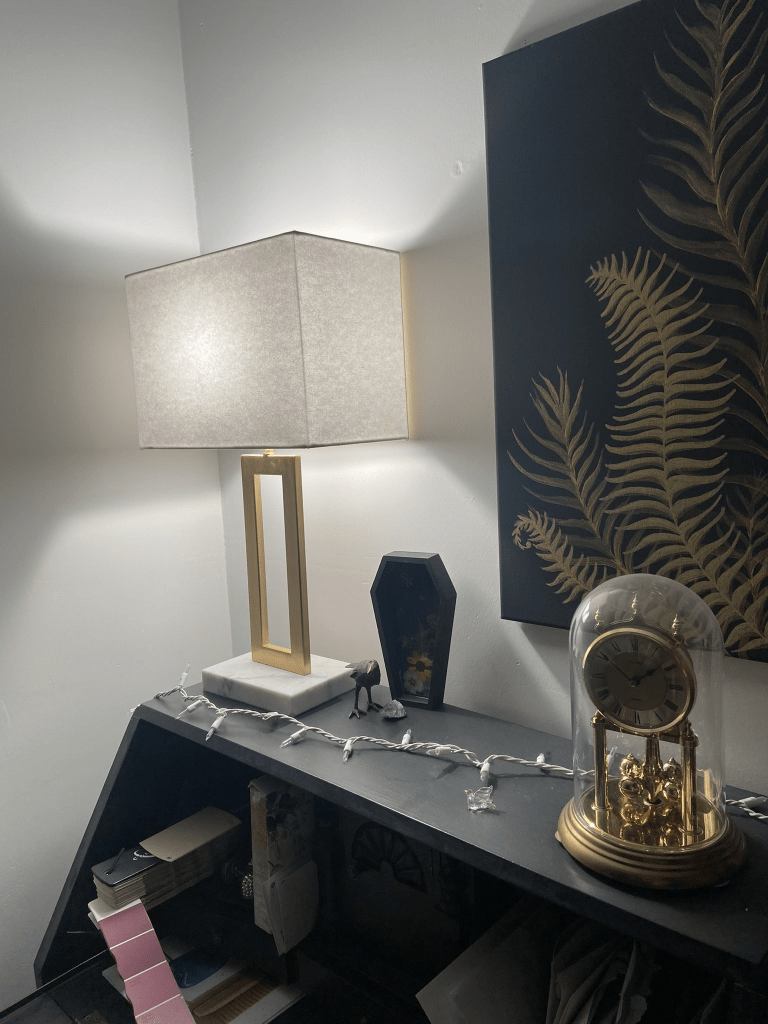
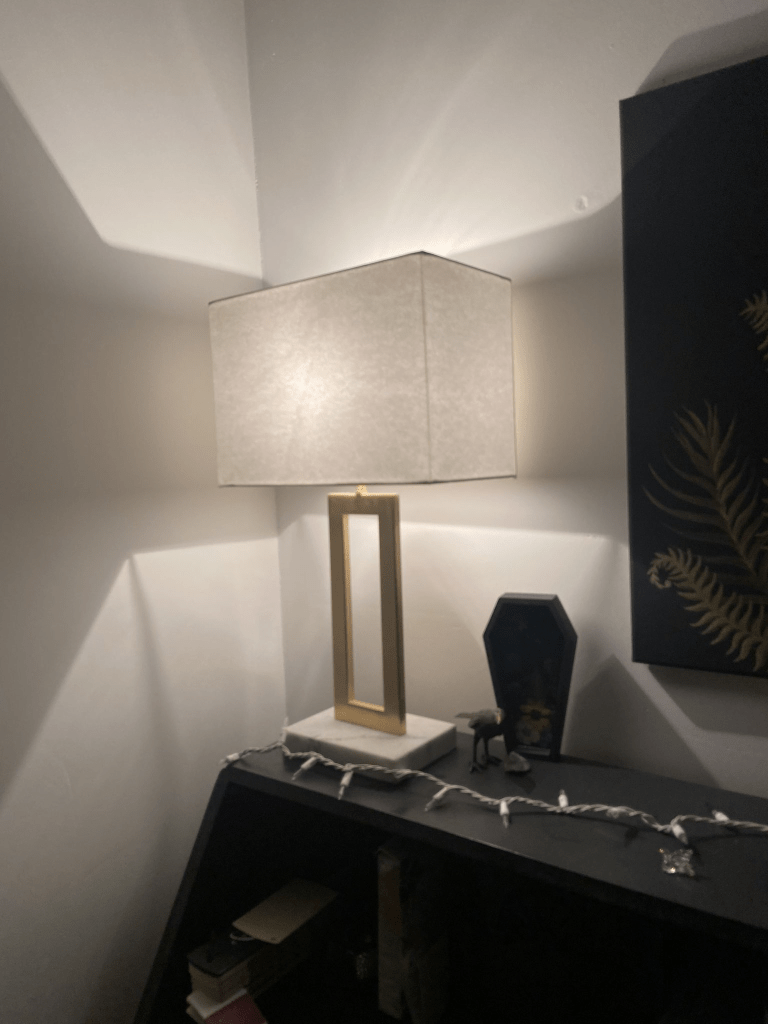
By changing from a 72W bulb to a 40W sunlight bulb with the base adaptor, even with the bright white walls the tone of the light bulb changes a big and a slightly dimmer warm light is emitted from the lamp. For a lot of folks, this small adjustment can be the difference in light harshness that allows people to work with the lights on vs working in the dark.
One note with the bulb adaptors is that when using smaller bulbs like the 40W sunlight bulb, the bulbs tend to be very fragile. It can be hard to get the bulb adequately twisted into place without it breaking – so although it may aesthetically be pleasing, it may end up being more expensive the more bulbs you break.
My second example is with my old bathroom light fixture:
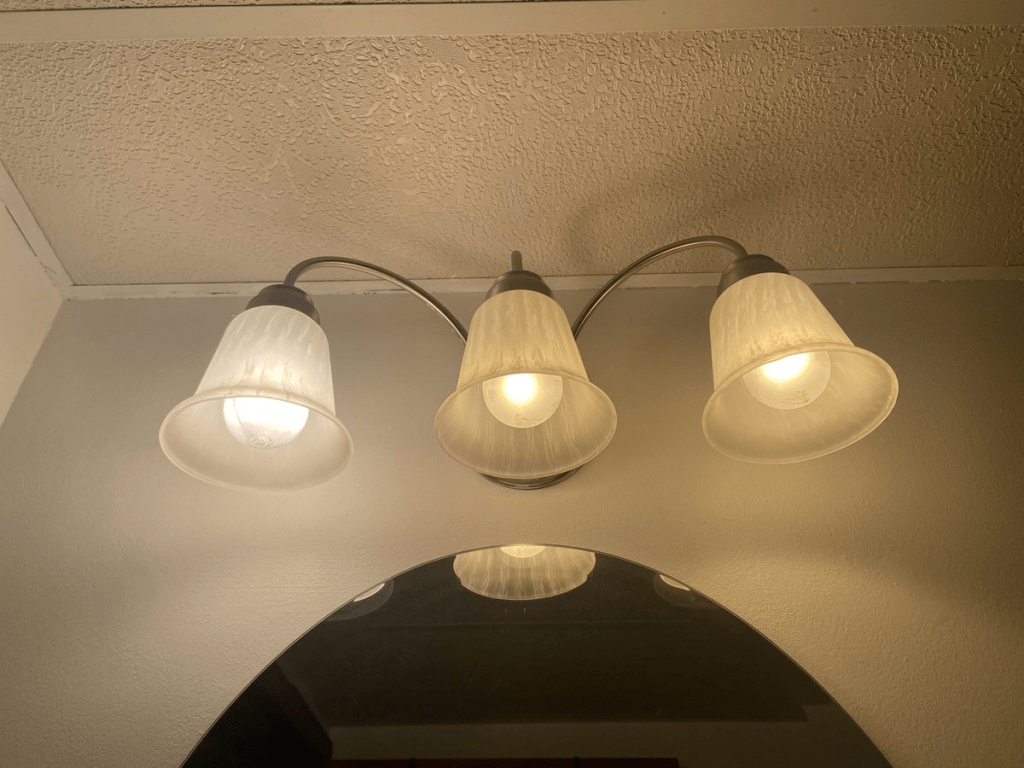
In this image I went to replace a burnt out bulb with something that I had on hand, which turned out to be a 72W compared to the two 60W bulbs on the right.
For most bathroom users, a bright light like a 72W bulb is preferred but for anyone reading this resource, I imagine you may have some light sensitivity concerns, and it’s not hard to understand why the far brighter 72W – especially if there were 3 of them – would make the space far too bright and relatively unusable. But, with this bulb situation, they no longer even make the 60W incandescent bulbs I was originally using.
I did eventually upgrade this light fixture, which brings us to our final light combination:
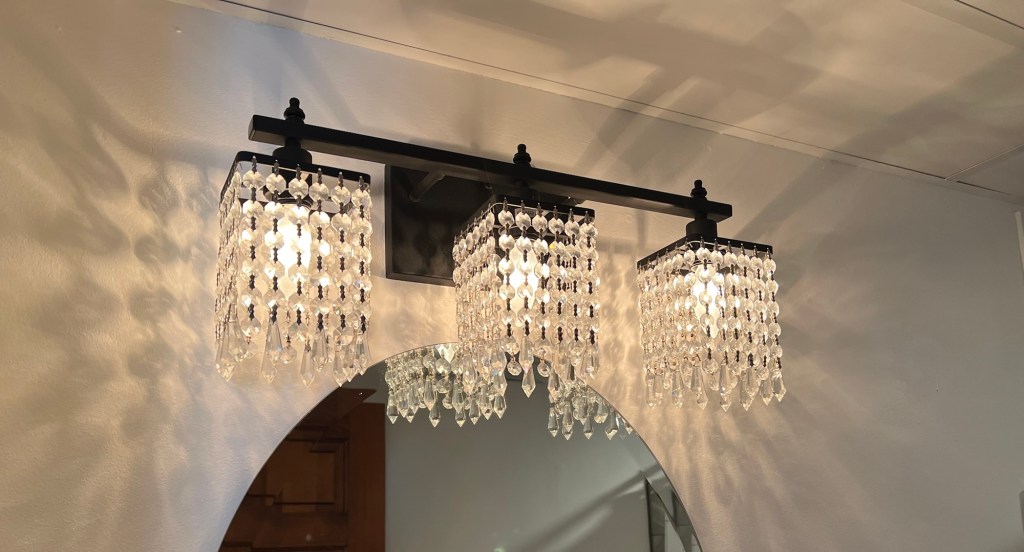
For this new fixture to maintain my slightly more ambient light in the bathroom I had to have a dimmer switch installed.
This particular chandelier works with chandelier bulbs – which can be a very bright white – especially once again surrounded by the white walls. To create the balance that I needed, the dimmer switch allows the bulbs to be lowered in intensity where they remain completely functional and can offer the brightness other people desire, but can be lowered as much as I need them to be.
Final Notes
Overall, choosing the right lighting for you is usually going to required a layered approach and may require full consideration of other people who you share space with. Your traditional three layers will be: overhead – often brighter lights that illuminate the entire space, accent – these are your lamps and additional pendants, plus your focal light fixtures and spotlights, and ambiance – which are your lowest lights providing a subtle glow including twinkle lights, candles, and nightlights.
There are aesthetic solutions, like choosing light fixtures with warm metallic interiors like bronze, copper, and gold; or opting for darker paint colors for all or a portion of your living space to diffuse your harsher light fixtures. And there are more technical solutions like adding in dimmer controls – which can be added where you plug in the fixture, or amended in the actual light switch – or taking advantage of different kinds of bulbs and knowing what kind of small devices can be added as adaptors in order to change the light by simply using a different bulb.
Of course, for many of us we can’t find the 40W and 60W bulbs anymore, so eventually light fixtures that we had been using alright will become too harsh with the newer more modern bulbs. This may mean changing out the fixture, or spending a little more on technical changes + even smart bulbs which give you a bit more color control.
I didn’t touch on smart bulbs here in this post because I don’t have experience with them and they can be a costly investment to set up. But, smart bulbs advertise a handful of features I’ve outlined here such as adjusting the amount of lumens they put out and the temperature of the bulb and even in some cases the color. I guess for me, I still really enjoy the old school warm lighting, so it’ll probably be a long time before I opt for any kind of smart technology for my own lighting needs.
Finally, the most important thing when it comes to picking out lights for your space is to think about how you really want to use the space and how lighting can help you accomplish that. The lighting that has clear task light functionality in my kitchen is very different than dimmable lights in my living room and twinkle lights in my bedroom which is all very different than the light fixture in my bathroom. Not every room has to be bright! It is okay to live in a cave sometimes and it is also okay to feel like you might just be in a speakeasy.
A.


Leave a Reply